
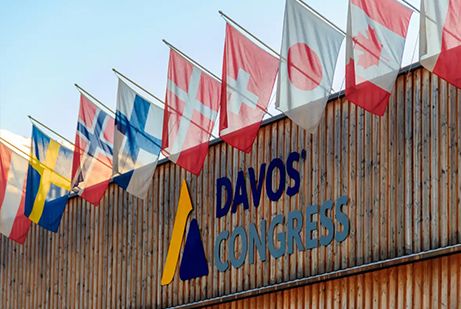
Every January for the last 55 years, something unusual happens in Davos.
One of Europe’s highest towns, perched at roughly 5,100 feet above sea level, Davos has a permanent population of about 11,000 residents. And yet, during the week of the Annual Meeting of the World Economic Forum , it welcomes an equal number — often more — of visitors into this small Swiss Alpine town in just a few days.
For most of the year, Davos is a quiet ski resort — snow-covered slopes, orderly streets, and a rhythm defined by winter tourism. Then, for one week in January, it becomes the centre of global attention. Motorcades replace ski buses. Cameras line the pavements. Hotel lobbies double up as meeting rooms. Cafés turn into negotiation spaces. A sleepy Alpine town briefly transforms into a place where the world’s biggest economic, political, and technological questions are debated — often all at once.
After a gap of two years, I head back to Davos next week — from 19 to 23 January — trading Delhi’s winter low of around 6°C for Davos at about –12°C. It feels familiar, and yet different. I have been to Davos over 35 times, and if there is one thing it does remarkably well, it acts as a global mood board. You don’t just listen to speeches here; you pick up signals —
The scale of the gathering explains that intensity.
The 56th Annual Meeting brings together over 60 heads of state and government, hundreds of ministers, central bank governors, and leaders of major multilateral institutions. President Trump is expected to join this year, alongside senior members of his administration, adding to the geopolitical weight of the conversations. Europe is being strongly represented by political and institutional leadership, while large delegations from Asia — including India, China, the Middle East, and Japan — and Africa underline that Davos continues to function as a genuinely global convening.
Add to this several hundred CEOs, global investors, Young Global Leaders, technology pioneers , social entrepreneurs, academics, cultural figures, commentators, and a sizeable international media presence, and it becomes clear why Davos feels so compressed and intense — so many decision-makers in such a small physical space for such a short period of time. Davos compresses months of debate into a single, intense week — a true Manthan.
The theme for this year’s meeting — A Spirit of Dialogue — sounds almost understated. But placed against today’s world of sharper geopolitics, noisier trade tensions, accelerating technological change, and societies under visible strain, it feels carefully chosen.
Dialogue this year is not about finding easy agreement. It is about managing differences, understanding red lines, and keeping channels open even when positions are far apart. In a more contested global environment, dialogue becomes a practical tool — not a diplomatic nicety. That intent shows up clearly in how the meeting itself is structured.
At the core is the official WEF programme — the pivot around which the entire week turns. This core programme includes over 300 sessions, most of them held inside the iconic Davos Congress Centre, which becomes the nerve centre of the meeting.
These sessions are organised around five core pillars this year , and even the numbers tell a story:
Geopolitics clearly leads. Growth follows closely. People and skills sit firmly in the middle. Innovation remains central, but now comes with sharper questions around governance and execution. Climate and planetary boundaries remain critical, but the emphasis is more pragmatic and problem-solving than aspirational. The message is subtle but unmistakable: before the world can fully solve for technology or climate at scale, it has to solve for trust, competition, and coordination.
AI is everywhere in this year’s programme, of course — but the tone is noticeably more grounded. Less hype, more realism. More focus on deployment, governance, skills, and who gets left behind. Climate conversations, too, are more execution-oriented — grids, finance, adaptation, and trade-offs, not just ambition.
Around this core sits the WEF Open Programme, with roughly 20–25 sessions — lighter in format, more conversational, and often good at surfacing ideas early. Beyond that is a substantial third layer: WEF-accredited partner programmes, about 150 sessions, hosted by companies, institutions, and organisations aligned with the Forum. This year, there are also meetings organised by the Swiss government — usually on trade, and this time, I understand, there will be one on security.
And then there is the other Davos ecosystem, as it is popularly known.
Breakfasts, working lunches, closed-door dinners, country showcases, company briefings, think-tank roundtables, one-toone meetings and issue-specific huddles. Add to that receptions, networking events, corridor conversations — and yes, the many, many cocktails. Hosted by governments, companies, NGOs, industry groups and alliances of every kind. Impossible to count. Impossible to avoid. The promenade — the Janpath of Davos — turns into a stretch of country lounges and company hubs, hosting back-to-back meetings and conversations. For a first-timer, it can be intimidating; my advice is simple — go with the flow and enjoy the experience.
Accommodation becomes notoriously hard to find. Not just because the official Annual Meeting is capped at around 3,000 accredited participants from roughly 130 countries, but because several thousand others arrive as part of the outer circle — CEOs, investors, young leaders, social entrepreneurs, start-ups, advisers, support teams and the world’s media. For those few days, the city becomes a security fortress — tightly controlled on the inside, buzzing with conversations everywhere else.
What Davos 2026 signals is a subtle shift in posture. Less certainty. More curiosity. Fewer declarations. More listening. Leaders do not pretend to have neat answers. They compare notes and stress-test assumptions in a world already in transition.
That, perhaps, is what A Spirit of Dialogue really means this year — not dialogue as theatre, but dialogue as a working tool to manage competition, navigate uncertainty and make incremental progress when consensus is harder, but cooperation remains unavoidable.
Ajay Khanna is the Co-Founder, PAFI and Co-Editor of The Policy Pivot. Views are personal.
