
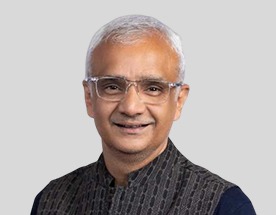
Shivnath Thukral, president of the Public Affairs Forum of India (PAFI), discusses how public affairs professionals can build trust with policymakers, navigate the implications of AI and strengthen collaboration across policy, communications and legal functions to safeguard organisational reputation.
As public affairs evolves amid rapid technological change, shifting policy priorities and growing stakeholder expectations, professionals must look beyond government engagement to understand the wider business and reputational implications of their work. In conversation with PRWeek India’s managing editor Rohan Moorthy, Shivnath Thukral, president of the Public Affairs Forum of India (PAFI) discusses the importance of raising professional standards, building trust with policymakers, navigating the implications of artificial intelligence and strengthening collaboration between public affairs (PA), public relations (PR) and legal teams. He also reflects on why evidence-based engagement, sound judgement and transparency remain central to the profession.
PRWeek: The Public Affairs Forum of India (PAFI) describes its purpose around aligning business, society and government, while emphasising trust, ethical engagement and evidence-based policy. Where do you think the public affairs profession in India needs to raise its own standards?
Shivnath Thukral: I strongly believe the standards that you refer to that this profession must aspire for is not just a destination, it is a constantly evolving space. With so many changing realities around us what we all as a community can do is to try and remain ahead of the cycle and emphasise on trusted engagement. This will need more data and evidence-based research, which support our arguments. One space which, I feel we all need to contribute is towards studies and analysis which, can strengthen our arguments instead of us asserting the “we feel or we think” approach. Also, building strong relationships remains the critical link in this ongoing journey.
PRWeek: Public affairs is increasingly expected to go beyond government engagement and anticipate changes in society, technology and geopolitics. How should the role of the public affairs professional evolve?
Thukral: If you ask anyone who practised this profession a couple of decades ago, they will tell you that knowing your industry domain was good enough along with the rolodex. But we are no longer living in that world. There is information, innovation and uncertainty coming at us from every direction. There is not a minute to sit still, and so the policy professional must remain agile and aware of almost everything that a CEO needs to know. To say that I don’t know enough about my balance sheet or a product change is not acceptable. So, if I were to say one thing about the role evolution, it is to expand your horizons and take responsibility for the organisation and not just your work stream.
There is information, innovation and uncertainty coming at us from every direction. There is not a minute to sit still, and so the policy professional must remain agile and aware of almost everything that a CEO needs to know.
PRWeek: India’s digital economy is developing rapidly, while regulation is often trying to keep pace. What makes for a productive conversation between technology companies and policymakers?
Thukral: What works best is to have a level of trust and honesty in your conversations. It may not work all the time as you may face resistance from the policymaker, which to me is an opportunity. You need to win them over to at least start a conversation. I am a big believer on human instincts and building trust amongst all stakeholders. Second, I would say is to recognise that sovereign has far more powers and responsibility than you ever will and that means you must try to see the issues from their lens as well. It is not good enough to say since you come from the tech or digital world, you know it all. While your mandate is on behalf of the organisation, one needs to find a win for both sides.
PRWeek: You have spoken about the impact of new digital technologies on society. With AI now accelerating that transformation, what do you think policymakers and businesses are still underestimating?
Thukral: I do not think anyone is intentionally underestimating AI. It is just that the pace of it can at times be overwhelming. In India, we are lucky to have leaders who do not shy away from recognising the power of AI. They are seeing an opportunity. India’s own initiatives both at the government level and in the private sector shows we want to seize the moment. However, most of the large-scale deployments and innovations are happening in the West, so we must remain always engaged to showcase the implications and applications of this technology. This is where policy professionals again have a role. If you represent a tech company in India, you owe it to your company and the country to share as much knowledge with policymakers. That way both can help create a win-win for Indians.
In India, we are lucky to have leaders who do not shy away from recognising the power of AI. They are seeing an opportunity. India’s own initiatives both at the government level and in the private sector shows we want to seize the moment.
PRWeek: Does the rise of AI change the fundamentals of public affairs or does it simply make the need for good judgement, evidence and human relationships even more important?
Thukral: I would say all the above! I see the rise of AI as a part of the ever-evolving technology eco-system. It is more impactful than let’s say when cell phones or the Internet came about. But AI cannot be an end so we must see it as a chance to add value to what we do. Plus, we all need to be mindful of its implications, which can be very significant. What AI does not change is that a policy professional remains honest, truthful, sensitive and a transparent interlocutor for the organisations they represent.
PRWeek: Public affairs has traditionally focused on policy, government and regulatory stakeholders, while PR has focused more broadly on reputation and public perception. Where do you see the boundaries between the two today?
Thukral: There are two ways to look at it. If you sit in the CEO’s chair, would they really see each of these streams as separate areas or how all of them put together affect the organisation. Now if you see it from a particular work stream lens you may see them as having boundaries. The ideal way to look at anything, which affects the overall business is to stay close to each other’s work and understand how one enables the others individually and collectively. You cannot be so obsessed with boundaries that we forget how each work stream affects the overall business.
What AI does not change is that a policy professional remains honest, truthful, sensitive and a transparent interlocutor for the organisations they represent.
PRWeek: When an organisation is dealing with a contentious policy or regulatory issue, how should public affairs and communications teams work together without allowing advocacy to compromise credibility?
Thukral: Why just public affairs and communications, you must include legal in that as well. I believe in any policy centric organisation, it is legal which, draws the boundaries which, a business can push; policy plays within and communication ensures the overall approach lands well for the business in the public eye. Credibility cannot be owned by any single work stream. Imagine if policy does not tell legal what it advocated for and this goes out in the press, which affects the company’s position in the courts. We all lose! But if the opposite were to happen, it is the organisation which wins.
PRWeek: Looking ahead, do you see public affairs, public relations and corporate communications converging into a broader reputation and stakeholder-management function, or will the disciplines remain distinct?
Thukral: If you look at global organsiations, it is an acceptable position to have a global lead who oversees both from a reporting structure. That is to ensure exactly the point I make [where] we all need to be aware and stay coordinated with each other. But does that mean we must converge the two when it comes to actual practise, not necessarily. The nature of the job for each workstream is so different and the tools we deploy are very distinct in their nature. It is not easy for a policymaker to share their concerns with a communications person or at times even with legal, which is where policy comes in. But at the back end we all must stay coordinated.
Credibility cannot be owned by any single work stream. Imagine if policy does not tell legal what it advocated for and this goes out in the press, which affects the company’s position in the courts. We all lose! But if the opposite were to happen, it is the organisation which wins.
Shivnath Thukral is the President, Public Affairs Forum of India (PAFI), and Vice President of Public Policy and Government Affairs, PhonePe Limited. The views expressed are personal
